

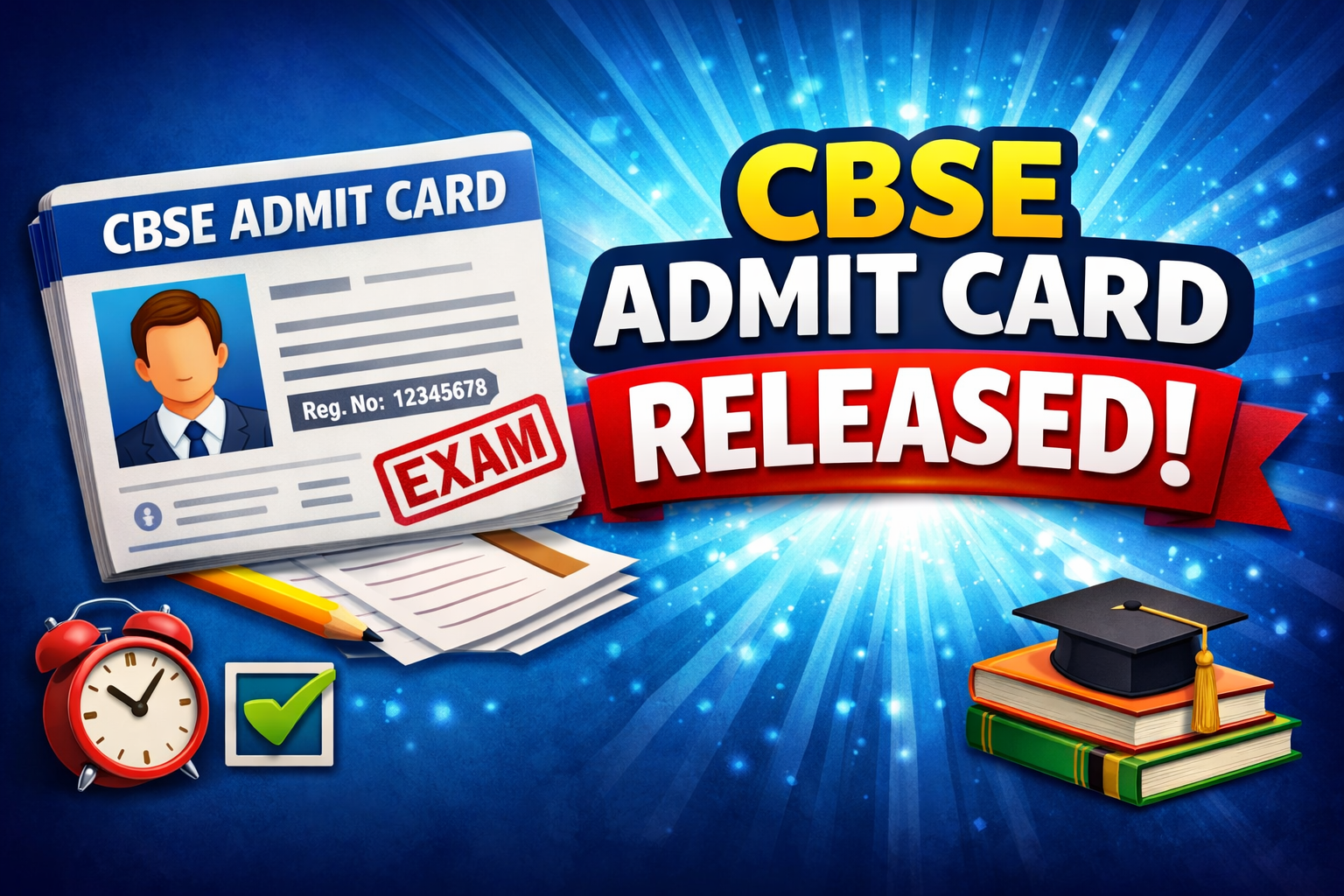
Strategic Analysis of the 2026 CBSE Examination Framework: Admit Card Protocols, Multi-Phase Assessment Structures, and the Integration of the APAAR Digital Identity System
The 2026 academic session represents a landmark transition for the Central Board of Secondary Education (CBSE), as it implements the first comprehensive structural reforms mandated by the National Education Policy (NEP) 2020. This shift marks the departure from a monolithic, high-stakes annual examination toward a more flexible, bi-annual assessment model for secondary school students. Central to this transformation is the 2026 Admit Card, which has evolved from a simple hall ticket into a sophisticated digital authentication document linked to a student’s lifelong academic identity. As the Board prepares to manage approximately 45 lakh candidates across Classes 10 and 12, the administrative infrastructure must accommodate over 40,000 subject combinations across thousands of centers in India and 26 foreign nations. This report provides an exhaustive analysis of the 2026 examination cycle, detailing the logistical mechanisms of admit card distribution, the mandatory integration of the Automated Permanent Academic Account Registry (APAAR) system, and the rigorous security protocols governing the examination centers.
The Administrative Calendar: Examination Cycles and Admit Card Availability
The scheduling of the 2026 board examinations reflects a complex dual-phase architecture designed to reduce academic pressure and provide students with multiple opportunities for performance improvement. The administrative cycle begins long before the theory exams, starting with the submission of the List of Candidates (LOC) by schools, which traditionally concludes by late September of the preceding year. For the 2026 exams, the Board issued a tentative date sheet as early as September 24, 2025, approximately 146 days before the start of examinations, to allow stakeholders sufficient time for planning.
link:https://www.cbse.gov.in/
Phase 1 and Class 12 Main Examination Timelines
The primary examination window for the 2025–2026 session is scheduled to commence on February 17, 2026, for both Class 10 and Class 12. The Class 10 Phase 1 examinations are slated to conclude on March 11, 2026, while the Class 12 examinations extend until April 10, 2026. This timeline was slightly adjusted by an official rescheduling notice issued on December 30, 2025, which moved examinations originally planned for March 3, 2026, to later dates due to administrative reasons. Specifically, Class 10 subjects scheduled for that day were shifted to March 11, and the Class 12 Legal Studies paper was deferred to April 10.
Admit cards for this main window are anticipated to be available during the last week of January 2026. Regular students will receive their hall tickets through their respective schools, while private candidates are expected to access the download portal on the official CBSE website, cbse.gov.in, around the same time
| Examination Component | Admit Card Release Window | Start Date | End Date |
| Class 10 Phase 1 (Main) | Jan 29 – Feb 5, 2026 | Feb 17, 2026 | Mar 11, 2026 |
| Class 12 Main Exam | Jan 25 – Feb 5, 2026 | Feb 17, 2026 | Apr 10, 2026 |
| Class 10 Phase 2 (Optional) | April 22, 2026 | May 15, 2026 | Jun 1, 2026 |
| Supplementary Exams | July 1 – July 8, 2026 | July 2026 | July 2026 |
Phase 2 and the Improvement Examination Framework
A defining feature of the 2026 reforms is the introduction of a second board examination for Class 10 in May. This Phase 2 is an optional assessment intended for students who wish to improve their marks in up to three subjects or those placed in the “Compartment” category after Phase 1. The Phase 2 admit cards are scheduled for release on April 22, 2026, shortly after the declaration of Phase 1 results on April 20, 2026. The compressed timeline between the results of Phase 1 and the commencement of Phase 2 necessitates a high degree of administrative efficiency, with a brief five-day window for schools to submit the LOC for Phase 2 candidates
Digital Identity Integration: The APAAR ID Mandate
The 2026 examination cycle introduces a mandatory digital identity protocol: the Automated Permanent Academic Account Registry (APAAR) ID. Aligned with the “One Nation, One Student ID” initiative, the APAAR ID is a 12-digit lifelong identifier designed to track a student’s academic journey from pre-primary to higher education.
The Role of APAAR in Admit Card Verification
Starting with the 2026 board exams, the APAAR ID is a prerequisite for registration and subsequent admit card generation. This digital nexus allows the Board to consolidate student records, including report cards, exam results, and extracurricular achievements like sports or Olympiads, into a single secure platform integrated with DigiLocker. The linkage of APAAR ID with student registration aims to eliminate duplicate records, prevent the issuance of fake certificates, and streamline the verification process across different educational institutions and databases.
Implementation Process for Institutions and Students
The generation of an APAAR ID requires the student’s full name, date of birth, gender, and Aadhaar number for authentication. Schools are tasked with conducting parent-teacher meetings to explain the significance of the ID and obtaining signed consent forms before proceeding with the UDISE+ portal registration. To monitor this transition, the CBSE has developed the “APAAR ID Monitoring (AIM)” online system, ensuring that 100% saturation is achieved before the board examinations commence. For the student, the APAAR ID serves as a “digital passport,” facilitating easier transitions between schools and simplifying future applications for higher education or professional employment.
Structural Analysis of the Bi-Annual Class 10 Assessment Model
The transition to a two-phase board examination system for Class 10 in 2026 is an operationalization of Para 4.37 of the NEP 2020, which seeks to mitigate the “high-stakes” nature of a single annual exam.
Phase 1: The Mandatory Main Examination
The first examination, held in mid-February, is considered the mandatory “Main Examination” for all Class 10 students. It covers the full syllabus prescribed for the academic year. Students must participate in this phase to be eligible for the subsequent improvement phase. Internal assessments and practicals are conducted only once, prior to the Phase 1 theory exams, and these marks remain constant across both phases.
Phase 2: The Optional Improvement and Compartment Window
The Phase 2 examinations, conducted from May 15 to June 1, 2026, are optional and targeted toward students seeking to improve their performance in core subjects—specifically Science, Mathematics, Social Science, and languages—or those needing to clear a compartment. Under the 2026 guidelines, a student who has passed but is dissatisfied with their Phase 1 score can reappear in up to three subjects. The “Best of Two” score logic is then applied, allowing the student to retain the higher mark from either attempt for their final passing certificate.
Outcomes and Academic Continuity
The Phase 2 results are declared by late June, allowing successful candidates to secure admission into Class 11 without delay. The Board provides a provisional admission pathway to Class 11 after the Phase 1 results, which is then finalized based on the Phase 2 performance. This dual-track system provides a significant psychological buffer, as students no longer face the prospect of losing an entire academic year due to a single poor performance.
Admit Card Acquisition and Logistics: Institutional and Individual Pathways
The 2026 admit card distribution process maintains a strict division between regular and private candidates to ensure institutional accountability and candidate security.
Protocols for Regular Students
For students enrolled in CBSE-affiliated schools, the admit card acquisition is an institutional process. Schools access the CBSE portal—specifically the Pariksha Sangam or the Main Website—using unique login credentials where the affiliation number serves as the User ID. Once downloaded, the admit cards must be printed and validated.
A critical requirement for the validity of the hall ticket is the tripartite signature protocol. To be considered an authorized document for entry into the exam hall, the card must bear the signatures of the student, a parent or guardian, and the school principal, along with the official school stamp. This verification cycle ensures that all parties have confirmed the accuracy of the personal details and the subject choices listed on the document.
Protocols for Private Candidates
Private candidates, including those appearing for improvements or compartment subjects, must manage the download process independently. The CBSE provides a dedicated portal (cbseit.in) for private candidates where hall tickets can be retrieved using multiple authentication paths:
-
Application Number: The unique identifier generated during the online form submission.
-
Previous Roll Number and Year: Authenticating via the credentials of a prior board attempt.
-
Candidate Details: Searching using the candidate’s name along with the names of their mother and father.
Private candidates are further mandated to carry a government-issued photo identity proof (such as an Aadhaar card or voter ID) alongside the printed admit card for secondary verification at the examination center.
Anatomy of the 2026 Admit Card: Information and Data Fields
The 2026 admit card is an information-dense document that serves as the primary reference for both the student and the invigilation staff. Meticulous verification of every field is essential to avoid administrative friction on the day of the exam.
Essential Identifiers and Logistical Details
The card features personal identifiers, including the student’s full name, parents’ names, date of birth, and the unique CBSE Roll Number. Additionally, the Admit Card ID is printed on the document, which is a necessary field for accessing results online. Logistical information includes the school code, center code, and the specific name and address of the examination center.
Subject Codes and Examination Schedules
The document provides a chronological list of the examinations the student is registered for, accompanied by specific subject codes and examination timings. Most major theory papers are conducted from 10:30 AM to 1:30 PM, but students must verify the specific duration for vocational or elective subjects, which may conclude by 12:30 PM
Private candidates are further mandated to carry a government-issued photo identity proof (such as an Aadhaar card or voter ID) alongside the printed admit card for secondary verification at the examination center.
Category Subject Name Subject Code Timing Core Mathematics (Standard) 041 10:30 AM – 1:30 PM Core Mathematics (Basic) 241 10:30 AM – 1:30 PM Core Science 086 10:30 AM – 1:30 PM Core Social Science 087 10:30 AM – 1:30 PM Language English (Language & Literature) 184 10:30 AM – 1:30 PM Language Hindi Course-A 002 10:30 AM – 1:30 PM Elective Information Technology 402 10:30 AM – 12:30 PM Elective Computer Applications 165 10:30 AM – 12:30 PM
The Significance of Subject Code Accuracy
The accuracy of subject codes on the admit card is paramount, as the CBSE uses these codes to manage the distribution of unique question papers and the subsequent evaluation process. For instance, a candidate mistakenly registered for Hindi Course-A (002) instead of Hindi Course-B (085) will face significant difficulties at the center, as the curriculum and examination patterns differ. If any discrepancy is found, the student must contact the school principal immediately to initiate the correction process through the CBSE Regional Office.
Regulatory Governance: Examination Center Integrity and Security
To maintain the sanctity of the 2026 board examinations, the CBSE has institutionalized a rigorous set of guidelines governing student behavior and permitted materials within the examination centers.
Entrance and Reporting Protocols
Students are required to report to the examination center at least 30 to 45 minutes prior to the scheduled start. Entry into the examination venue is strictly closed at 10:00 AM. This early reporting allows time for mandatory, extensive physical frisking and the administrative tasks of distributing answer booklets and question papers.
Regular students must attend the examination in their full school uniform, which aids in identification and promotes academic decorum. Private candidates are advised to wear light, simple clothing to expedite the security check process.
Prohibited Items and Unfair Means Categories
The Board has maintained a strict stance on “Unfair Means” (UFM). The possession of any barred item, even if not utilized for cheating, is considered a violation of the rules and can lead to immediate disqualification and a multi-year ban from appearing in further board examinations.
| Permitted Items | Barred Items (Strictly Prohibited) |
| Original Admit Card and School ID | Mobile Phones, Bluetooth, Earbuds, Smartwatches |
| Blue/Royal Blue Ink/Ballpoint/Gel Pen | Calculators, Log Tables (provided by center), Whitener |
| Geometry Box (Compass, Protractor, Eraser, Scale) | Textual Material (Printed/Written), Bits of Paper |
| Transparent Water Bottle and Pouch | Wallets, Goggles, Handbags, Pouches |
| Analogue Watch (Simple) | Digital Cameras, Pagers, Scanners, Pen Drives |
| Metro Card, Bus Pass, Money | Any Open or Packed Food (except for diabetics) |
Specific provisions are made for diabetic students, who are permitted to carry necessary food items and medicines provided they have the required medical certificates. Furthermore, students with learning disabilities, such as dyscalculia, may use a calculator provided by the examination center, subject to prior approval under Circular No. CBSE/COORD/2020.
Security Architecture and the “Unfair Means” Framework
The 2026 guidelines divide offenses into categories based on severity. Category 1 offenses, such as having previous years’ question papers or writing on non-prescribed materials, may result in the cancellation of the specific paper. Category 2 offenses, including the fabrication of photographs on the admit card or erasing information on the answer book, lead to the cancellation of the entire current examination cycle. The most severe violations, Category 3, such as smuggling out question papers or the possession and use of electronic communication devices, result in a two-year ban from all board examinations.
Regional Administration and Error Correction Mechanisms
The operational success of the 2026 examinations depends on the efficiency of the CBSE’s Regional Offices (ROs). For the Uttar Pradesh region, including major urban centers like Kanpur, the Regional Office in Prayagraj (formerly Allahabad) serves as the primary administrative authority.
The Prayagraj Regional Office Jurisdiction
The Prayagraj Regional Office oversees affiliated schools in numerous districts across Uttar Pradesh, including Kanpur Nagar, Kanpur Dehat, Lucknow, Varanasi, Gorakhpur, and Jhansi. Its functions include managing the conduct of public examinations, overseeing the affiliation of new schools, and providing support services like the verification of academic documents and the issuance of duplicate certificates.
Contact Information for CBSE Regional Office Prayagraj:
-
Address: Plot No-35-B, Near Civil Station, M.G. Marg, Civil Lines, Prayagraj (Allahabad) – 211001.
-
Regional Officer: Shvetta Arora.
-
Telephone: 0532-2400119.
-
Email: roallahabad.cbse@nic.in.
Admit Card Error Correction Procedures
Errors on the admit card must be rectified before the examination commences to ensure there are no challenges to the student’s identity or subject eligibility during the board exam. The correction procedure involves the following steps:
-
Immediate Notification: The student must report the error to the school’s examination coordinator or principal as soon as the card is received.
-
Documentation Review: The school compares the error against the original registration data submitted during the LOC process.
-
Regional Approval: If the error stems from a mistake in the Board’s data processing, the school submits a formal correction request to the Regional Office in Prayagraj. This must be accompanied by relevant supporting documents like the birth certificate or the school’s admission register.
-
Re-issuance: Upon approval, the Board authorizes the school to print a corrected admit card or provides an official amendment letter to be carried alongside the original document.
Private candidates who face issues with their admit cards, such as download failures due to incorrect application numbers, can seek assistance via the CBSE Helpline (1800-11-8002) or by visiting the nearest regional office.
Technological Support and Planning Tools for Candidates
Recognizing the logistical challenges of reaching distant examination centers, the CBSE has introduced several technological aids to assist students in the 2026 cycle.
The CBSE Exam Centre Locator App
To mitigate pre-exam anxiety and ensure students can find their designated centers without difficulty, the Board has integrated center location data into its mobile application. By entering their Class, Roll Number, and APAAR ID, students can access the exact address, photo, and map location of their examination center. The app includes a “How to Reach” feature that calculates travel time based on real-time traffic data, which is especially useful for students in high-congestion urban areas.
Strategic Travel and Preparation Advice
Candidates are strongly advised to visit their designated examination center a day or two before the first paper. This practice allows the student to familiarize themselves with the route, identify potential traffic bottlenecks, and understand the entry points of the venue. Given that weather or sudden administrative changes can occur, the Board recommends having a secondary mode of transport planned for contingencies.
Synthesis: The Evolving Role of Assessment in the NEP 2020 Era
The 2026 CBSE board examination system is more than a logistical exercise; it is the manifestation of a fundamental shift in educational philosophy. By moving away from the “one-shot” examination model, the Board is attempting to align Indian education with global standards of continuous and flexible assessment.
Reducing the Pedagogical Impact of High-Stakes Exams
The introduction of bi-annual examinations for Class 10 is explicitly designed to reduce the reliance on coaching centers and rote learning. By offering a second chance within the same academic cycle, the Board incentivizes students to focus on competency-based mastery rather than transient performance. Furthermore, the multidisciplinary subject choices now becoming available reflect the NEP 2020’s goal of breaking down the rigid boundaries between arts, science, and commerce streams.
Institutional Responsibility and Digital Governance
For educational institutions, the 2026 cycle demands a higher level of digital literacy and administrative precision. The management of the APAAR ID system, the coordination of two separate examination windows, and the rigorous enforcement of security protocols place significant demands on school leadership. However, the result of this digital transformation is a more transparent, secure, and student-friendly examination ecosystem. The 2026 Admit Card, as the primary document of this new era, symbolizes the transition toward a more integrated and humane approach to secondary education in India. Success for the candidate in this environment requires not only academic preparation but also a meticulous adherence to the administrative and digital requirements that ensure the integrity of the board examinations
Understanding the CBSE 2026 admit cards is crucial for students preparing to take their examinations. These admit cards serve as essential identification documents that grant access to examination centers and provide vital details such as the exam schedule, subject codes, and candidate information. It is imperative for students to verify all information contained within the admit card to avoid any discrepancies on the exam day. Familiarity with the admit card process ensures a smoother experience during the examination period.
Understanding CBSE 2026 Admit Cards is akin to navigating a well-structured roadmap before embarking on a journey; it provides essential directions and necessary information to ensure a smooth and organized experience for students during their examination process.
RELATED POSTS
View all


पौष पूर्णिमा 2026 और पुरी श्रीक्षेत्र का प्रशासनिक एवं सांस्कृतिक विश्लेषण: एक व्यापक शोध प्रतिवेदन
January 2, 2026 | by arunkumarknj1976@gmail.com

Lakers, Austin Reaves, Return, and Injury Update.
February 4, 2026 | by arunkumarknj1976@gmail.com

खेल की 5 बड़ी खबरें: Virat-Rohit के कॉन्ट्रैक्ट और Saina Nehwal का संन्यास
January 20, 2026 | by arunkumarknj1976@gmail.com